Chyavanprash is a specific Ayurvedic preparation, not a generic name for every herbal syrup, jam, or immunity product. By the end, you will know how to identify its formulation, assess realistic benefits, use it safely, and compare products sold in Mumbai.
Key takeaways
- Chyavanprash is a sweet, semisolid Ayurvedic avaleha centred on amla.
- Treat it as a traditional rasayana, not a replacement for disease treatment.
- Check ingredients, serving guidance, sugar content, batch details, and storage instructions.
- Ask a clinician before use if you have diabetes, allergies, or take regular medicines.
What Chyavanprash Is and How It Differs from Other Herbal Products
Chyavanprash is an Ayurvedic avaleha: a thick, sweet herbal preparation made by cooking fruit pulp, herbs, sugar, and other ingredients into a semisolid paste. Amla is a familiar central ingredient, and Ayurveda traditionally classifies chyavanprash as a rasayana, used for nourishment and maintaining vitality rather than treating one named disease.
This is the practical answer to what is chyavanprash for ayurvedic products in mumbai: it is one category of traditional Ayurveda supplements and herbal foods.
Chyavanprash is not a single standard recipe. Classical formulas contain many ingredients, while manufacturers may omit, substitute, or add ingredients for taste, cost, availability, manufacturing, or regulatory reasons. Compare the ingredient panel, serving size, sugar, and carbohydrate content instead of assuming that every jar is equivalent.
Chyavanprash differs from other herbal products in purpose and structure:
| Product | What it is | Key difference |
|---|---|---|
| Single-herb supplement | One concentrated herb or extract | Focuses on one ingredient and its intended use |
| Herbal syrup | A liquid herbal preparation | Usually designed for measured liquid dosing, not a cooked avaleha paste |
| Fruit jam | A sweet fruit spread | Food product without chyavanprash’s traditional multi-herb formulation |
| General “immunity” product | A marketing category | The phrase does not prove prevention of infection or treatment of disease |
Because chyavanprash is usually sugar-dense, check the label carefully if you have diabetes, prediabetes, insulin resistance, or a prescribed carbohydrate limit. It is an adjunct, not a replacement for diagnosis, prescribed treatment, vaccination, sleep, or medical care.
What Chyavanprash Benefits Mean in Traditional and Modern Terms
A reasonable expectation is modest: chyavanprash may provide nutritional support and fit Ayurveda’s traditional rasayana approach to maintaining vitality. Its sweet, energy-dense base can contribute calories, while amalaki and other herbs supply the preparation’s traditional identity. These effects do not guarantee that you will feel stronger or fall ill less often.
Traditional rasayana language points to support for:
- Strength and general nourishment
- Appetite and digestion
- Voice and complexion
- Resistance to everyday illness
The phrase chyavanprash benefits is often shortened in advertising to “immunity support.” Treat that as a traditional-use description, not clinical proof. A jar labelled “immunity booster” does not prove prevention of colds or other infections, and it cannot cure asthma, diabetes, infertility, or another diagnosed condition.
Do not use it as a substitute for vaccination, adequate sleep, a balanced diet, prescribed medicine, or medical evaluation. Persistent fever, breathing difficulty, unexplained weight loss, or uncontrolled glucose needs clinical attention rather than a trial of chyavanprash.
Also remember that many formulations are sugar-dense; if you have diabetes, prediabetes, insulin resistance, or a prescribed carbohydrate limit, count the label’s sugar and carbohydrate before treating it as a health food.
How to Take Chyavanprash and Judge Whether It Suits You
Take the serving printed on the jar, not a spoonful copied from another brand. Formulations and serving sizes differ. After breakfast is a practical time for many products; follow the label if it specifies before food or another schedule.
- Measure the stated amount in grams or level spoonfuls with the supplied measure or a clean, dry teaspoon. Do not use a heaped household spoon.
- Take it plain, or mix it with warm—not scalding—milk or water. Choose water if milk causes bloating or does not fit your diet.
- Use the same serving daily for two to four weeks before judging usefulness, unless a clinician or the label gives a different duration. Stop sooner for a rash, stomach upset, wheezing, or other new symptom.
Check the nutrition panel before starting: chyavanprash is often sugar-dense, so count its sugar and total carbohydrate if you have diabetes, prediabetes, insulin resistance, or a prescribed carbohydrate limit. The phrase “chyavanprash benefits” does not prove that the product prevents infections or treats disease.
Mumbai’s heat and humidity demand careful storage. Close the lid immediately, keep the jar in a cool, dry cupboard away from sunlight and steam, and use only a dry spoon. Refrigerate it only when the label instructs you to. Discard it if you see mould, bubbling, separation with an unusual smell, or a broken seal.
Who Should Check with a Clinician Before Starting It
Do not start chyavanprash without individual advice if you have diabetes, prediabetes, insulin resistance, or a prescribed carbohydrate limit. Its sugar and total carbohydrate count matter, even when the jar is sold as one of many traditional Ayurveda supplements.
Check with a clinician before using it if you:
- are pregnant, breastfeeding, or considering it for a child;
- have liver or kidney disease, food allergies, asthma, or a history of reacting to herbal products;
- take anticoagulants, diabetes medicines, immunosuppressants, or several prescription medicines;
- are replacing a prescribed treatment with it, or have uncontrolled blood glucose.
Show the complete ingredient panel, serving size, and batch details to your doctor or pharmacist. Recipes vary, so the word “chyavanprash” does not identify one fixed formulation.
| Concern | What to do | Why it matters |
|---|---|---|
| Rash, facial swelling, wheezing, or trouble breathing | Stop it and seek urgent care | These can signal a serious allergic reaction |
| Repeated vomiting, severe abdominal pain, or persistent diarrhoea | Stop it and contact a clinician | The product may not suit you, or another illness may be present |
| Unusually high glucose or symptoms such as excessive thirst and frequent urination | Stop it and obtain medical advice | The sugar load or medicine interaction needs review |
| Persistent fever, breathing difficulty, unexplained weight loss, or worsening symptoms | Seek conventional medical evaluation | Chyavanprash cannot replace diagnosis or disease treatment |
A clinician can decide whether it fits as an adjunct after assessing your medicines, diet, symptoms, and health history—not as a substitute for prescribed care or Panchakarma.
How to Compare Chyavanprash among Ayurvedic Products in Mumbai
The label matters more than the jar’s name. The question “what is chyavanprash for ayurvedic products in mumbai” cannot be answered from the word chyavanprash alone, because recipes differ in amla, herbs, sweeteners, and added ingredients.
Compare these details before choosing among ayurvedic products in mumbai:
| Item | What to compare | Why it matters |
|---|---|---|
| Full ingredient list | Amla, herbs, sweeteners, additives, and quantities where declared | Different recipes are not chemically identical |
| Sugar and carbohydrate | Grams per serving, serving size, and total servings | Sugar-dense products affect diabetes, prediabetes, insulin resistance, and carbohydrate limits |
| Product identity | FSSAI food or health-supplement details versus a licensed Ayurvedic medicine | These categories are not automatically equivalent |
| Traceability | Manufacturer name, address, batch number, licence or manufacturing information, and expiry date | Missing details make quality and recall checks difficult |
| Storage directions | Temperature, moisture protection, and use after opening | Mumbai heat and humidity can alter texture and spoilage risk |
Do not treat a study of one formulation as proof for every jar. Human research remains limited and varies in ingredients, dose, design, and sample size.
An Ayurvedic clinic can review the complete label alongside your age, digestion, glucose control, allergies, symptoms, diet, and medicines. TRITATTVAM AYURVED can help assess whether the formulation fits your needs, but persistent fever, breathing difficulty, weight loss, or uncontrolled glucose requires medical evaluation.
Show the label to your doctor or pharmacist if you take anticoagulants, diabetes medicines, immunosuppressants, or several medicines.
Related service
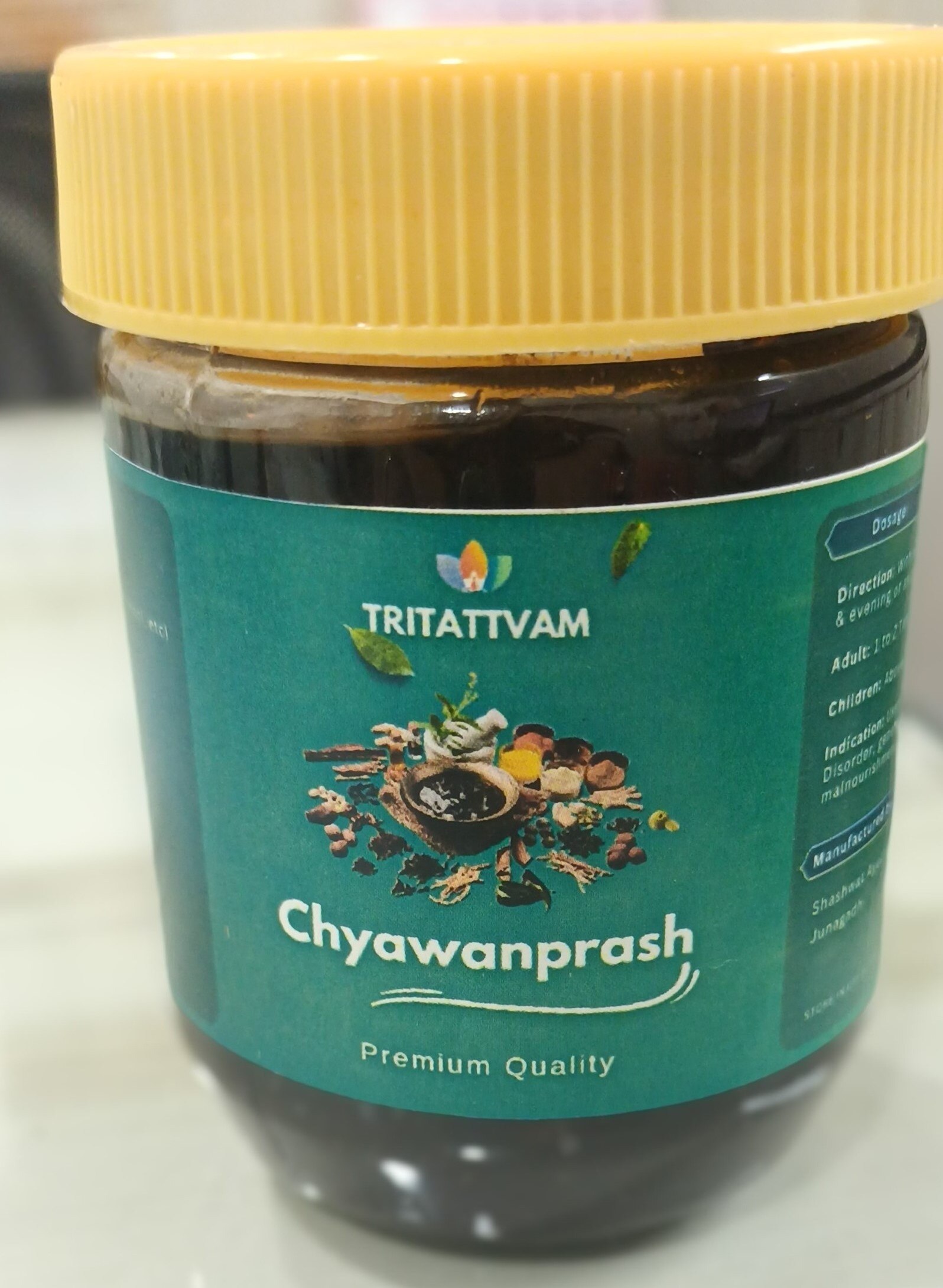
PRODUCTS CHYAVANPRASH ₹300 Immunity Booster |
Frequently asked questions
What is chyavanprash used for?
Ayurveda uses chyavanprash as a rasayana for nourishment, vitality, and general wellness rather than for treating one named disease.
How is chyavanprash different from other Ayurvedic products?
Chyavanprash is an avaleha, a cooked semisolid preparation containing fruit pulp, herbs, sugar, and other ingredients. Capsules, powders, oils, and decoctions use different forms and serving methods.
How should you take chyavanprash?
Follow the product label or your clinician's instructions, check the serving size and sugar content, and do not assume a larger serving provides greater benefit.
Who should consult a clinician before taking chyavanprash?
Ask a clinician first if you have diabetes, food or herb allergies, digestive symptoms, a chronic condition, are pregnant or breastfeeding, or take regular medicines.
How can you compare chyavanprash products in Mumbai?
Compare the full ingredient list, batch number, manufacturing and expiry dates, storage instructions, sugar content, dosage guidance, manufacturer details, and seal condition.
Keywords